The bad times are attributed to the different Grahas (Planets), and their position in the current time. These Grahas can be appeased by performing Pooja and Pushpanajali. Pushpanjali is arranged every month or on date of birth of the person ,other special occasions, on the eve of a new venture etc.
Hindu astronomy is based upon the configuration of the nine planets and their collective influence on the world in general and each individual in particular. Depending upon where these planets are located at the time of a person’s birth, Hindus believe that the possibilities and potentialities of his life and energies are determined well in advance.
The nine planets are collectively known as navagrahas. They are found in most of the Hindu temples either grouped together on a panel or in a separate pavilion. The devotees usually offer their respects to the nine planetary gods before offering prayers to the main deity of the temple. Out of the nine gods the names of seven are actually drawn from the names of the planets of the solar system and also correspond to the names of the seven days of the Hindu calendar week.
The remaining two gods are actually demons who managed to gain a place in the pantheon through an act of trickery. Probably they were either comets or rather the dark and somewhat hostile planets of the solar system (Neptune and Pluto), which might have been known intuitively or psychically to ancient Indian astrologers.
A brief description of each of the Navagrahas is given below:
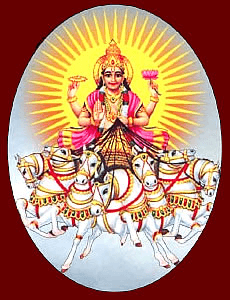 |
Surya (Sun) : He is the Sun god, also called Ravi. In the company of the other planets, he generally stands in the center facing east, while the other planets stand around him in eight different directions, but none facing each other. He rides a chariot that has one wheel and pulled by seven while horses. The seven horses symbolically represent the seven colors of the white light and the seven days of the week. |
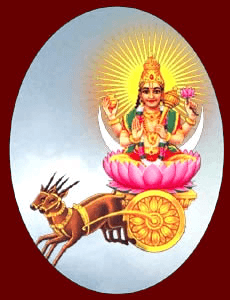 |
Chandra (Moon) : Also knows as Soma, and probably because of his waxing and waning qualities, in the images he is never depicted in full. We see him with only his upper body from chest upwards, with two hands holding one lotus each, riding upon a chariot drawn by 10 horses. |
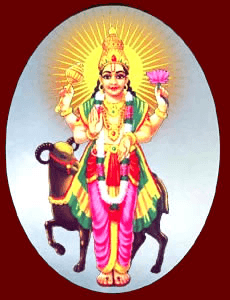 |
Mangala (Mars) : Also called Angaraka, Mangala is a ferocious god with four hands. In two hands he holds weapons, generally a mace and a javelin, while the other two are held in abhaya and varada mudras. He uses ram as his vehicle |
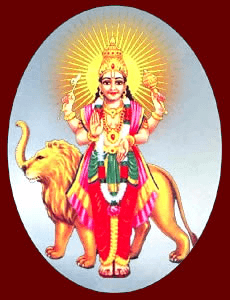 |
Budha (Mercury) : We generally see him depicted with four hands, riding upon a chariot or a lion. Three of his hands hold a sword, a shied and a mace respectively, while the fourth one is held in the usual varada mudra (giving gesture). |
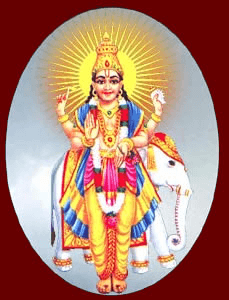 |
Brihaspathi (Jupiter) : Brihaspati also known as Brahmanaspati is the teacher of gods and is praised in many hymns of the Rigveda. He is generally shown with two hands, seated in a chariot driven by eight horses. The eight horses probably represent eight branches of knowledge. |
| IMAGE |
Sukra (Venus) : Sukra is the teacher of the demons and the author of Sukraniti. He is generally shown with four hands, riding upon a golden or a silver chariot drawn by eight horses. Three of his hands hold a staff, a rosary, a vessel of gold respectively while the fourth one is held in varada mudra. |
| IMAGE |
Sani (Saturn) : Sani is a turbulent and troublesome god who makes and breaks fortunes by his influence and position in the planetary system for which he is invariably feared and especially worshipped by those who believe in Hindu astrology. He is generally shown with four hands riding upon a chariot, or a buffalo or a vulture. In three hands he shown holding an arrow, a bow and a javelin respectively while the fourth one is held in varadamudra. |
| IMAGE |
Rahu : His image resembles that of Budha (Mercury) in some respects but both gods differ fundamentally in their nature and temperament. He is generally shown riding a dark lion, in contrast to the white lion of Budha. But just like the other god, he carries the same weapons, namely a sword, a javelin and a shield in his three hands, while his fourth hand is held in varadamudra. |
| IMAGE | XXXXX |
Customized Homam
The Homam to be performed depends on the type of problems & the individual’s Birth Chart, usually a Pundit is consulted for advice on the type of homams that are to be conducted. If you have any doubts please ask to our Pundits. A detailed analysis of your Horoscope chart, by our Pundits would suggest you the most suitable remedies or if to conduct special poojas for specific problems at specific temples, that would help you over come your problems and to obtain evident good results with the Power of Cosmic Energy.
How Can I Get This Homam Performed?
By analyzing your horoscope, our experienced Pundits can identify the reason for the problems and the ways to nullify the problems. Based on your Birth Chart and on the instructions given by our Pundit, selective Homams are performed by Our Experienced Priests. Our Priests has vast experience in the field of performing Homams & Poojas. They have sound knowledge on the various aspects of performing homams. The main aim of performing the Homams is to enrich positive energy of the ruling planets and to nullify the negative elements shown in the birth chart. It is also a form of remedial measure which has been followed from the ancient times. Homams and poojas performed for a particular deity by invoking Agni – the God of fire. It is said that when Lord Brahma (the creator among the Trinity) created man, he also created “Homam” for man’s livelihood and his attainment of spiritual desires.