Originally the personification of the mantra, the goddess Gayathri is considered the Veda Mata, the mother of all Vedas and the consort of the God Brahma and also the personification of the all-pervading Parabrahman, the ultimate unchanging reality that lies behind all phenomena. Gayathri Veda Mata is seen by many Hindus to be not just a Goddess, but a portrayal of Brahman himself, in the feminine form. Essentially, the Goddess is seen to combine all the phenomenal attributes of Brahman, including Past, Present and Future as well as the three realms of existence. Goddess Gayathri is also worshipped as the Hindu Trimurti combined as one. In Hindu mythology, there is only one creation who can withstand the brilliance of Aditya and that is Gayathri. Some also consider her to be the mother of all Gods and the culmination of Lakshmi, Parvati and Sarasvati.
Gayathri Goddess is typically portrayed as seated on a red lotus, signifying wealth. She appears in either of these forms:
– Having five heads with the ten eyes looking in the eight directions plus the earth and sky, and ten arms holding all the weapons of Vishnu, symbolizing all her reincarnations.
– Accompanied by a white swan, holding a book to portray knowledge in one hand and a cure in the other, as the goddess of Education.
According to the Hindu pantheon the ultimate power is the `Brahman’ and Sri Gayathri is the Cosmic form of that power. Still not many Hindus are aware of the importance and beneficial effects of Sri Gayathri Goddess Worship. In the ancient days, the Gayathri mantra, referred to as the `Brahma Gayathri’ was chanted by all people three times daily after the stipulated ablutions called the Sandhya Vandan. In order to do that everyone had to go through certain samskaras prescribed for the purpose.
Gayathri Mantra is sometimes called ‘Maha mantra’ i.e. ‘Great Mantra’ or ‘Great Shlok’. It is the most important and popular ‘mantra’, so much that people have personified it as goddess ‘Gayathri’.
The Gayathri Mantra is a highly revered mantra in Hinduism, second only to the mantra Om. The Gayathri Mantra is chanted as follows.
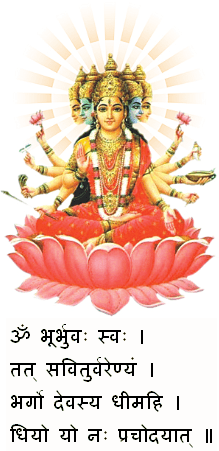 |
Translation in English: OM = Almighty God |
This Mantra is a formula taken from the Yajurveda, and the verse 3.62.10 of the Rigveda (which is an example of the Gayathri Mantra). Since all the other three Vedas contain much material rearranged from the Rig Veda, the Gayathri mantra is found in all the four Vedas. The deva invoked in this mantra is Savitr. In Atharva Veda, the Gayathri mantra is different from the regular Gayathri mantra.
By many Hindus, the Gayathri is seen as a Divine awakening of the mind and soul, and within it a way to reach the most Supreme form of existence, and the way to Union with Brahman. Understanding, and purely loving the essence of the Gayathri Mantra is seen by many to be one, if not the most powerful ways to attain God.
The much-maligned Varnasrama, categorising people into groups, according to the profession pursued by them, degenerated into the worst form of social evil the caste system in the course of the past thousands of years. The degeneration was so deep that certain groups were denied the opportunity of worshipping Sri Gayathri Devi or chanting the Gayathri mantra. It is the primary objective of the Trust, formed to establish the Sri Gayathri Ashram, Inc. A Non-Profit Religious Organization, that has created the awareness among the people about the Gayathri Mantra, the chanting of which cleanses the body and the mind, and the need for Sri Gayathri Goddess Worship.
“Mananena thrayathe anenethi manthraha” (that which protects the person who chants it is the mantra). Each of the alphabets of the Sanskrit language and their combinations are said to be Beejaksharas. Each one is said to have the basic potency of a mantra representing a particular Cosmic Power form. Combinations of such Beejaksharas give rise to the formation of specific Cosmic Forms. They are called Mantras and often they have, in addition to the Beejaksharas certain phrases signifying the prowess of the Devatha. All the deities worshipped by Hindus say Ganesa, Muruga and so on have specific mantras and chanting them leads to propitiation of the respective Devatha. Intensive meditation on the deity while chanting the mantra will lead to the communion of the person with the Devatha. Hinduism is “pantheistic,” that is believing in and worshipping many gods as against the monotheistic nature of religions that believe in one god. Worship of several gods is not, however, incompatible with one’s faith in one Supreme Power. The scriptures say, “sarva deva namaskarah Kesavam prati gachati” (worship of all gods goes towards Kesava, the supreme power), “Ekam sat, viprah bahudha vadanti” (the truth is but one, the learned talk about it in many ways). The essence is that the worship of any god form will ultimately lead to the supreme power.