Homa (also known as homam or havan) is a Sanskrit word which refers to any ritual in which making offerings into a consecrated fire is the primary action. Homas are an important religious practise in Hinduism, Buddhism and Jainism.
Homa and Aradhana is basically offering of intensive Puja to different GODS and GODDESSES. Some say it Homa Puja, Some say it Homam or Homan. People do Homa Puja and Aradhana to get faster spiritual effects or to get results like – To get a peace and happiness in mind, peace at home (griha shanti) and workplace, For protection from miseries, fulfillment of wishes and for spiritual benefits. Homa puja or Homam or Homan is also done for prosperity, material abundance (money and wealth), and spiritual prosperity. In Homa Puja the prist offer Puja to the respective God, lighting up the fire which is call Homa Kund and offering there many items or Puja ‘Upachar’. It is also done for a speedy recovery from illness, for starting a new business or a new project so that the no any evil forces or effects can hamper the growth, To remove troubles that prevent us from starting a spiritual path, For getting married, For a smooth life, peace and harmony in the family, to improve family relations, for sustaining the family, for departed souls.
Although a consecrated fire is the central element of every homa ritual, the procedure and items offered to the fire vary by what occasions the ceremony, or by the benefit expected from the ritual. Procedures invaribly involve –
* The kindling and consecration of the sacrificial fire;
* The invocation of one or more divinities; and,
* The making of offerings (whether real or visualized) to them with the fire as via media, amid the recitation of prescribed prayers and mantras.
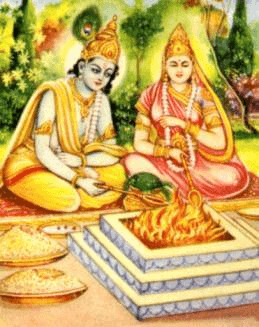 The consecrated fire forms the focus of devotions; it is often maintained on specific types of wood and other combustibles. The fire-altar (vedi) is generally made of brick or stone, and is almost always built specifically for the occasion, being dismantled immediately afterwards. This fire-altar is invaribly built in square shape. While very large vedis are occasionally built for major public homas, the usual altar may be as small as 1 x 1 foot square and rarely exceeds 3 x 3 feet square. Again, whereas major altars at public events may include a hollowing of the earth to create a relatively deep pit, usual altars involve no such excavation and indeed rise only inches above the ground.
In all events, the arrangement is centered in the middle of a space, which may be either outdoors or indoors. The principal people performing the ceremony and the priests who instruct them through the rituals seat themselves around the altar, while family, friends and other devotees form a larger ring around that center. The length and procedure of a homa depends on the purpose to which it is performed; many different types of homas exist, and the following list is only illustrative.